
The 2026 IP Revolution: How US Courts are Reshaping Intellectual Property Law

The landscape of American Intellectual Property (IP) law has historically moved at a measured pace, often trailing behind the rapid-fire evolution of technology. However, 2026 has marked a definitive shift. As generative AI matures from a novelty into an industrial backbone and biotechnology reaches new frontiers in gene editing, the US federal court system has been forced to redraw the boundaries of ownership.
From the halls of the Supreme Court to influential appellate rulings in the Ninth and Federal Circuits, the legal definitions of “authorship,” “fair use,” and “patent eligibility” are undergoing their most significant transformation since the Digital Millennium Copyright Act. For legal scholars, practitioners, and students, staying abreast of these shifts is no longer optional—it is a prerequisite for professional competence.
The AI Authorship Deadlock: Humans in the Loop
The defining IP battle of 2026 centers on the “Human-in-the-Loop” doctrine. Following the precedent-setting 2024 rulings that denied copyright to fully machine-generated works, the US Copyright Office and federal courts are now grappling with the percentage of human intervention required for protection.
In early 2026, the District Court for the District of Columbia ruled in Specter v. United States Copyright Office that a work must demonstrate “substantial creative control” by a human to be eligible for copyright. This means that a simple prompt is insufficient; the human must prove they iteratively refined the output to a degree that the AI acted merely as an advanced paintbrush rather than the artist.
Navigating these complex legal theories can be a daunting task for students pursuing JD or LLM degrees. Many find that seeking expert myassignmenthelp is the most efficient way to dissect these evolving precedents. By utilizing professional law essay writing help, students can better understand how 2026 rulings differ from 20th-century copyright standards, ensuring their academic work reflects the most current judicial thinking.
Patent Eligibility and the “Modernized” Section 101
For years, Section 101 of the Patent Act—which defines what is eligible for a patent—was a source of profound ambiguity, particularly for software and diagnostic tools. In 2026, the Federal Circuit clarified this via the “Functional Innovation Test.”
This new judicial framework moves away from the abstract “Alice/Mayo” test that plagued the 2010s. Instead, courts are now focusing on whether an invention provides a “specific, technical solution to a tangible problem,” regardless of whether that solution is implemented via software. This has opened the floodgates for a new wave of MedTech and FinTech patents that were previously deemed too “abstract” for protection.
The Fair Use “Transformative” Rebound
The legacy of the Andy Warhol Foundation v. Goldsmith (2023) case continues to ripple through 2026. US courts have tightened the definition of “transformative use.” In recent 2026 decisions involving data scraping for Large Language Models (LLMs), the Second Circuit ruled that using copyrighted data to train a model that competes directly with the original creator’s market does not constitute fair use.
This “Market-Substitution” pivot is a major win for content creators, musicians, and journalists, signaling that the “move fast and break things” era of tech development must now account for the economic rights of the original data owners.
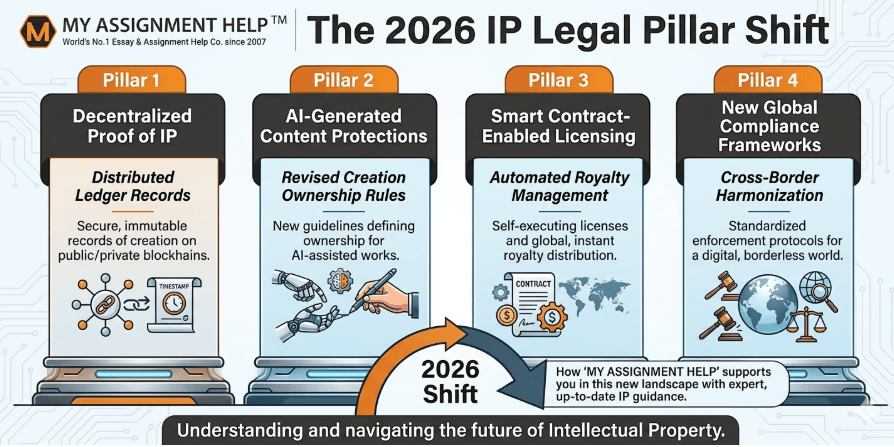
The Rise of Trade Secret Litigation in Remote Environments
With the “Hybrid Work” model now codified into American corporate culture, 2026 has seen a 30% spike in trade secret litigation. Courts are increasingly holding companies to a higher standard of “reasonable efforts” to maintain secrecy.
In CyberDyne Systems v. Former Employees, the court ruled that if a company does not implement specific, hardware-level encryption for remote workers, they effectively forfeit trade secret protection. This has led to a massive overhaul in corporate compliance and IP security protocols across the Silicon Valley and beyond.
Biotech and the “Natural Phenomenon” Debate
2026 has brought clarity to the patenting of CRISPR-Cas9 variants and synthetic biology. The Supreme Court recently declined to hear a challenge to the “Synthetic Sequence Rule,” which allows for the patenting of lab-created DNA sequences that do not exist in nature, even if they perform functions similar to natural proteins. This distinction is fueling billions of dollars in R&D investment within the US pharmaceutical sector.
Global Harmony or American Exceptionalism?
While the US courts are moving toward stricter AI regulations and clearer patent eligibility, there remains a tension with international standards, particularly the EU AI Act. US judges in 2026 have trended toward “Economic Pragmatism,” prioritizing the protection of American innovation over the more precautionary approach seen in Europe.
For students overwhelmed by the intersection of international treaties and domestic case law, it is often wise to pay someone to do my homework to ensure that comparative legal analyses are accurate and up to date with the latest 2026 treaties.
Key Takeaways for 2026
- Human Authorship Required: Pure AI-generated content remains uncopyrightable; “Substantial Creative Control” is the new legal benchmark.
- Section 101 Clarity: The “Functional Innovation Test” makes it easier to patent software that solves specific technical problems.
- Fair Use is Narrowing: Training AI on copyrighted data is increasingly viewed as an infringement if the output competes with the original creator.
- Trade Secret Hardening: “Reasonable efforts” for secrecy now require sophisticated digital infrastructure for remote workforces.
See also: Cryptocurrency Security: Best Practices for Beginners
Frequently Asked Questions (FAQ)
1. Can I patent a software algorithm in 2026?
Yes, provided it meets the “Functional Innovation Test.” It must provide a specific technical solution rather than just being an abstract mathematical concept.
2. Who owns the copyright if I use AI to write a book?
Under the 2026 Specter ruling, you only own the copyright if you can prove you exercised significant creative control and iterative refinement over the AI’s output.
3. Has the US signed any new IP treaties in 2026?
The US has entered into the “Sino-American IP Accord of 2026,” which focuses on reciprocal protection of trade secrets in the manufacturing and AI sectors.
4. Is data scraping legal for AI training?
Current 2026 rulings suggest that scraping is legal for non-commercial research, but commercial LLMs are increasingly being forced to license data from primary sources.
About the Author
James R. Sterling, Senior Legal Consultant & Academic Strategist James Sterling is a seasoned legal scholar with over 15 years of experience in Intellectual Property law. Currently a senior strategist at myassignmenthelp, James specializes in helping students and professionals navigate the intersection of technology and the law. He holds a JD from a Tier-1 American law school and has published extensively on the legal implications of emerging technologies. When not dissecting appellate court rulings, he mentors the next generation of legal writers in maintaining academic integrity and E-E-A-T standards in legal research.
Data Sources and References
- United States Copyright Office (2026): Circular 92: Updated Guidance on AI-Assisted Works.
- Federal Circuit Bar Journal (Winter 2026): The Functional Innovation Test: A New Era for Section 101.
- Supreme Court of the United States (2026): Docket No. 25-1044: Synthetic DNA and the Bounds of Nature.
- American Bar Association (2026): Report on Trade Secret Litigation Trends in the Hybrid Work Era.
- Journal of Intellectual Property Law & Practice: Comparative Analysis of the US and EU AI Regulatory Frameworks (April 2026).